

Opening a hospital isn't like opening a restaurant or a retail store. Before a single patient can walk through the doors, years of planning, state approvals and countless decisions happen behind the scenes.
In 1975, a group of Charlotte orthopedic surgeons cleared one of the biggest hurdles: They received permission to establish the Orthopedic Hospital of Charlotte.
But the person who might be most responsible for shaping the hospital from day one wasn't one of those surgeons.
She was Marilyn Mitchum, a 35-year-old nurse manager at Charlotte Memorial Hospital who had built a reputation for efficiency in the operating room. When the surgeons asked her to become the new hospital's operating room supervisor, she was surprised.
"I wasn't the most experienced nurse manager," Mitchum recalled. "In fact, I was the youngest."
She would become the hospital's first employee. And although her title never suggested it, Mitchum quickly became the person everyone — from nurses to surgeons — looked to for answers, helping turn an ambitious idea into a thriving hospital.
Award-winning orthopedic care and service.
Broad scope of responsibility
Mitchum’s work started long before her first day on the job and encompassed a lot.
- Design consultant. The new hospital was owned by Nashville-based Hospital Corporation of America (HCA). In 1975, Mitchum was still working at Charlotte Memorial, but on her days off, she’d fly to Nashville to meet with the architects designing the new hospital’s interior. They needed the insight of an OR nurse. “You have to know which way to open the doors and where the scrub sinks are,” she said.
- Procurement department. A new hospital needs everything from scalpels to sticky notes. Mitchum had to anticipate everyone’s needs and order all supplies. And this was before Google, email, or even computers. She procured office furniture and supplies, hospital beds, waiting room furniture and all that was required in the four operating rooms — adjustable operating tables, surgical lights, sterilizers, everything.
- Chief HR officer. Mitchum was a one-woman human resources department, helping determine staffing needs and then recruiting, interviewing, hiring and training support staff.
It was a lot for one person to take on, but Mitchum didn’t doubt herself.
“I’d grown up on a farm in Anson County,” she said. “I was used to hard work and doing whatever needed to be done.” She was also academically strong, graduating as valedictorian of her high school class — though she jokes that the honor “doesn’t mean much since I was in a class of 12.”
Safety, efficiency, comfort
Mitchum could do — and did — nearly anything, though typing wasn’t her strength. She asked the doctors for permission to hire a secretary, and they readily agreed, as they did with most of her requests.
The next step was hiring a chief nursing officer. The hospital administrator at the time, Richard Salerno, “was an excellent manager,” Mitchum said. “He hired Jean Crawford, an outstanding, educated lady with all the right credentials.”
Crawford, who Mitchum called “an asset to the hospital,” joined in 1977 and stayed for the rest of her career. The two are still in touch today.
In May 1996, Mitchum wrote a reflection, published by Presbyterian Hospital, about the orthopedic hospital’s first 20 years. She wrote about the construction, the equipment orders and the design of spaces for optimum efficiency. But then, as always, her focus was on people. She recalled wondering if she’d be able to find people willing to work at a new, not-yet-proven facility. “I hope I have never lost sight of how important people are to an organization,” she wrote, “especially those with good attitudes.”
Mitchum developed a reputation for running a tight ship with a focus on patient safety and comfort. She was always busy, but never too busy to focus on the patient experience, and she expected the same of her nurses. “I was a stickler,” she said. “I told each nurse to be sure we welcomed every patient and assured them we planned to take good care of them.”
She looked for ways to run the hospital more efficiently and then implemented them. In the early years, the operating rooms didn’t have specified purposes; they could be used for any type of orthopedic surgery. Staff would wheel in the correct equipment needed for each type of surgery and then move it out afterward. Some of the equipment was heavy, so moving it was a big, time-consuming undertaking.
Mitchum had the idea to always keep the right equipment in the right room. One room was dedicated to hip replacements, another to knees, one to spines and another to sports medicine. “It just made more sense than moving all this stuff around,” she said.
When she wasn’t at work, she still had work on her mind. “I'd go home at night and think about ways we could be more efficient,” she said. That continued even after Charlotte Ortho merged with Presbyterian Hospital in 1998 to become Novant Health Charlotte Orthopedic Hospital. Mitchum said Crawford, the chief nursing officer, is largely responsible for helping blend two cultures seamlessly.
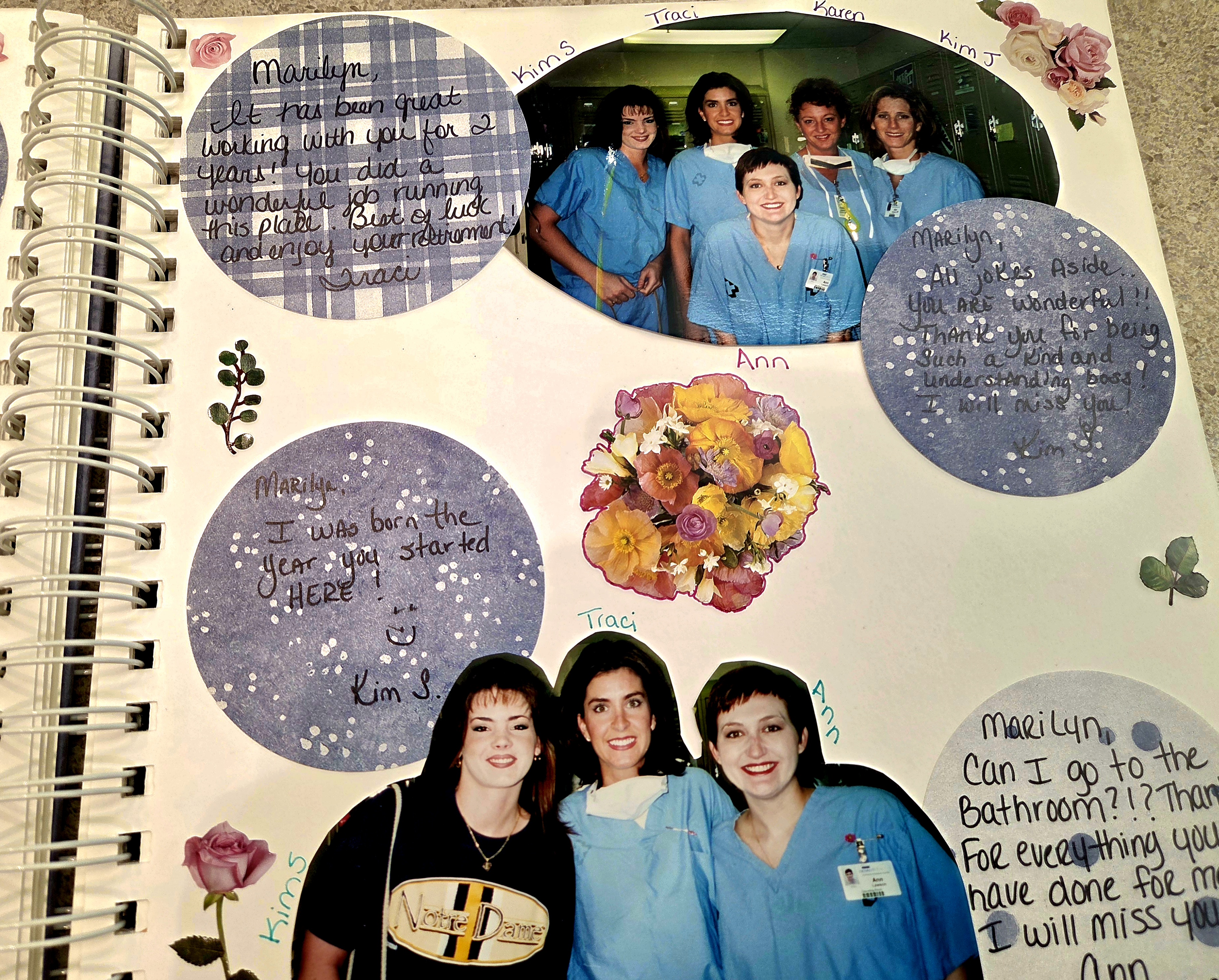
Mitchum spent the rest of her career at the hospital she helped design and operate. She retired in 2000, after 25 years at a place that felt to her like a second home. Her colleagues had a hard time adjusting to the post-Marilyn Mitchum era; they called her every day with some question or another for almost a year. She never minded answering.
Looking back, Mitchum said she had “a good life, a good career and worked with a good group of people. They were my friends, and they still are.”
In the past 50 years, many top-notch doctors, nurses and clinicians have helped patients resume full and active lives after surgery. (To learn more about all the advances in orthopedic surgery over the past 50 years, see our interview with Dr. David Homesley.) But few have left a more indelible imprint on the place, its policies and patients than Marilyn Mitchum.


