
Evidence keeps stacking up, showing strong primary care is essential to improving health outcomes and reducing healthcare spending in the United States. Appropriately, strengthening primary care has been a bipartisan priority for years.
Both the current Trump administration and the previous Biden administration put forward new policies and programs to address the shortage of primary care physicians (PCPs), prioritize primary care visits and preventive services in Medicare reimbursement, and to provide new value-based care incentives for the delivery of high-quality, affordable care.
Despite these efforts, primary care remains in a crisis and new regulations that cap federal loans for U.S. medical students and reclassify certain degrees, threaten to make the situation worse.
New lending limits
The United States has the highest medical school costs in the world. Medical students working on their graduate school degree pay on average more than $75,000 per year for tuition, room and board, according to data from educationdata.org.
Physician Assistants (PAs) and Nurse Practitioners (NPs), who deliver about 25% of all medical visits in the U.S. and receive consistently high patient satisfaction ratings, carry significant tuition costs as well. PA degrees currently average upwards of $98,000 for a 27-month program and NP degrees can cost anywhere from $20,000 to $166,000.
Student loans to cover those costs are getting more expensive due to changes at the federal level.
Major student loan provisions in the One Big Beautiful Bill Act (OBBBA) that took effect July 1 included:
- A $50,000 annual and $200,000 lifetime cap on federal loans for “professional” programs.
- Federal loans for “graduate” programs were also capped at $20,500 per year and $100,000 lifetime, respectively.
- Eliminating Graduate PLUS Loans, which allowed medical students to borrow up to the total cost of attendance after financial aid was applied, covering things like housing and living expenses.
Professional degrees are considered a higher level of graduate degree. Medical, PA, and NP degrees all fell under the “professional” category until the U.S. Department of Education passed the Reimagining and Improving Student Education (RISE) final rule in the spring of 2026 reclassifying many degrees. The change resulted in PAs and NPs being excluded from the “professional” category, leaving them eligible only for the lower “graduate” level federal loans.
Professional organizations sued the Department of Education over the reclassifications, arguing the $20,500 loan cap falls far short of the cost of a PA or NP education. That legal case is ongoing.
Why make these changes?
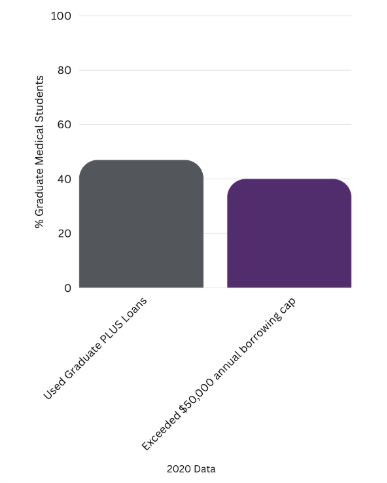
OBBBA and RISE were designed to reduce federal spending, discourage students from accumulating massive loan balances, and to create downward pressure on ballooning tuition. However, the loan changes have immediately created funding gaps for the 47% of medical students who use Graduate PLUS Loans and the 40% whose tuition costs exceed the $50,000 annual borrowing cap.
“The debt burden a student carries will have an impact on their specialty choice and the location for their practice,” said Dr. Joe Pino, senior vice president of medical education and research at Novant Health. “This could mean fewer graduates pursuing primary care in rural and underserved areas in our country.”
The limits on federal loans could force many students to turn to more expensive private loans, increasing their overall debt burden. Because some medical specialties offer salaries that are more than double those of primary care physicians, students carrying significant private loan debt may be more likely to choose higher-paying specialties.
“Students who are passionate about pursuing primary care and serving rural and/or underserved communities will continue to make this choice. However, student debt and limited access to student loans will have an impact on this decision,” Pino said.
Efforts and impacts
The tendency for young medical professionals to gravitate away from primary care is already happening. A review published this summer of laws enacted in 2021 and 2023 that funded 1,000 new Medicare-supported residency positions found that the laws did not expand the number of PCPs as intended. Primary care positions increased by just 2% and failed to draw as many clinicians to rural areas as policymakers had hoped. At the same time, the laws resulted in larger increases in specialty residency positions, 16% for radiology, and 13% for psychiatry.
Policymakers are pursuing other strategies to strengthen primary care. When the Centers for Medicare & Medicaid Services (CMS) proposed updates to the Physician Fee Schedule (PFS) in July 2026, CMS Administrator Dr. Mehmet Oz called the proposal, “some of the most significant Medicare reforms in recent years to strengthen primary care, expand accountable care, and modernize physician payment.”
PFS adjustments proposed this year and implemented in recent years have prioritized better accounting for the time, resources, and complexity involved in delivering primary care. However, because the PFS is strictly budget neutral, investment in primary care has come at the expense of specialty care, which has endured cuts consistently in recent years. The PFS must be reformed to move away from this system that shifts resources from one provider group to another, while also accounting for inflation.
Reforming primary care requires multiple, coordinated strategies that support physician training, expand preventive care, strengthen care coordination, and improve health outcomes while reducing avoidable hospitalizations. The new federal loan limits, the elimination of Graduate PLUS Loans, and reclassification of PA and nursing degrees take away from the effectiveness of these bipartisan efforts. By increasing the financial burden on medical students, more graduates are likely to be pushed toward higher-paying specialties and undermine policies designed to expand the primary care workforce and improve access to care, particularly in underserved communities.
“We need to continue to support medical student loans, grant opportunities for those who pursue primary care, especially rural and/or underserved areas, and more to continue to recruit and retain physicians in these communities,” Pino said.


