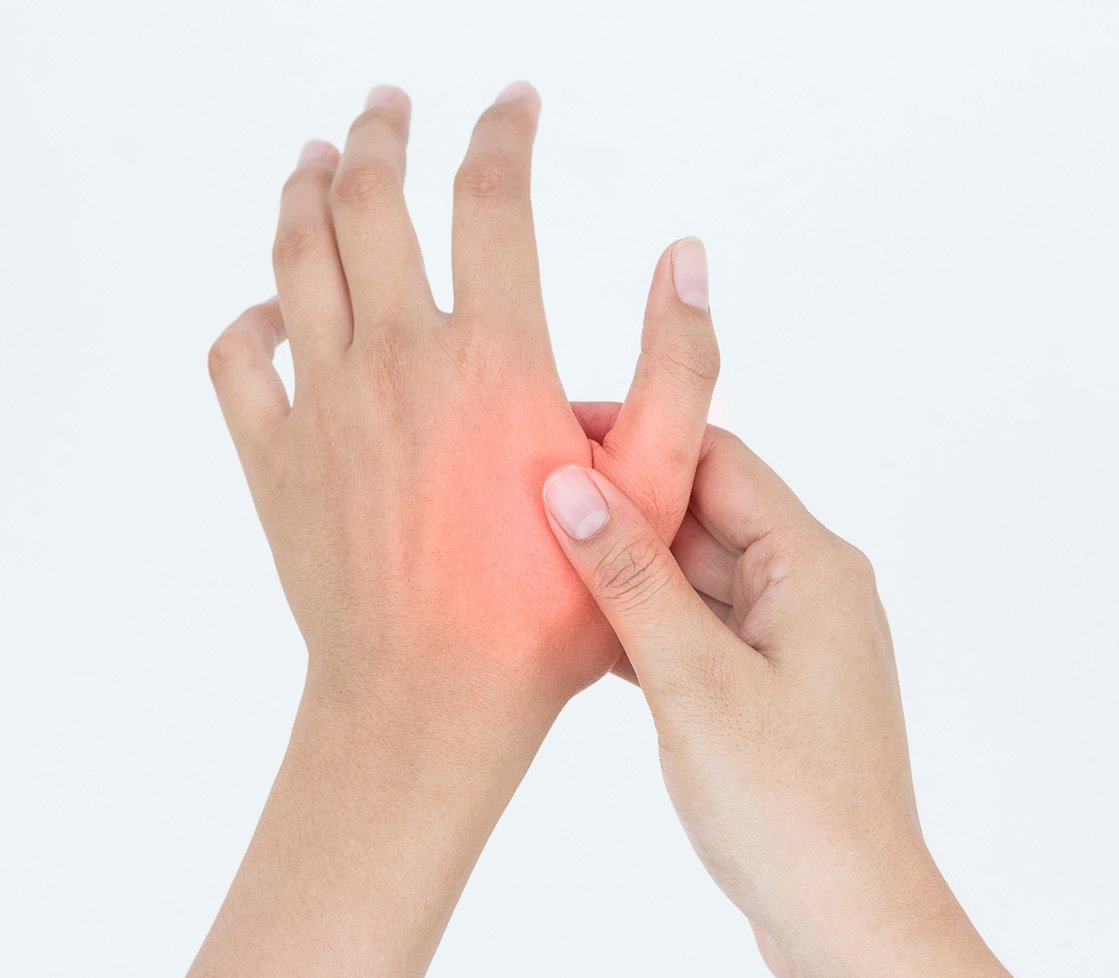
What is Thumb CMC (Basal Joint) Arthritis?
Arthritis literally means “inflamed joint," and generally refers to any damage to the joints of the body. There are 36 joints in the hand and wrist, and several sites that are commonly affected by arthritis. The joints are lined by a smooth white material called cartilage. Osteoarthritis is the most common type of arthritis and is a degenerative breakdown of the joint cartilage over time. Less common forms of arthritis include damage to the joint due to injuries (post-traumatic arthritis) and inflammatory arthritis (rheumatoid, gout, psoriatic).
Arthritis frequently affects the CMC joint (also called the basal joint) at the base of the thumb. It is the thumb joint located deep in the heel of the palm where the thumb metacarpal joins with a wrist bone called the trapezium. CMC osteoarthritis affects women more often than men, and may become symptomatic in some patients as early as their 30s or 40s.
Causes
There is still a lot unknown about what causes thumb CMC osteoarthritis. Genetic and hormonal factors play a role. Certain forceful repetitive “pinching” activities may either contribute to or aggravate CMC arthritis.
- Genetic, hormonal
- Repetitive forceful pinching activities
- Prior joint injuries
- Joint laxity (looseness)
- Inflammatory arthritis (rheumatoid)
![]()
Signs and symptoms
- Aching pain over the thumb CMC joint (heel of the palm)
- Worse with prolonged pinching or gripping (writing, driving)
- Cramping of the muscles in the palm
- Grinding sensation with use of the thumb
- Progressive deformity of the thumb
- “Bump” at the base of the thumb in heal of palm
- Hyperextension of the middle joint of the thumb (MP joint)
Is there a test for thumb CMC arthritis?
Yes! Your symptoms and medical history as well as an examination of your hand and wrist can help diagnose thumb CMC arthritis. X-rays of the thumb often show signs of arthritis, like bone spurs and cysts. Sometimes very early CMC arthritis does not show these changes on x-ray. If we suspect inflammatory arthritis or infection, we may need to order additional blood tests or an MRI to determine the case of the arthritis.
Treatment
Unfortunately, there is no cure for arthritis, but there are good treatments. Nonoperative treatments often adequately alleviate symptoms, but occasionally surgery becomes necessary.
Nonoperative treatment:
- Activity modifications (avoid forceful pinching, prolonged gripping)
- NSAIDS
- Thumb bracing
- Steroid injection
![]()
Thumb Spica Brace
Operative treatment:
A thumb CMC joint reconstruction (CMC arthroplasty) procedure can help with moderate or severe arthritis when nonoperative treatments do not provide sufficient relief. The most common variation of this procedure (LRTI procedure) involves removing the arthritic joint surface at the base of the thumb through a small incision, and then stabilizing the base of the thumb with tendons. This procedure take places in an operating room under sedation with a regional block to numb the arm. The recovery process usually takes about three months to regain functional use of the thumb. Postoperative care includes thumb splinting and hand therapy to ensure optimal recovery.
![]()
Postoperative Thumb Brace
Ready to confirm a diagnosis and fix the problem, or just want to learn more?
Our board-certified orthopedic hand and wrist surgeons, Eric Angermeier, MD and Kyle Kokko, MD, PhD, are here to help! They can often diagnose the problem in one visit, and get you started with a treatment plan. We offer a wide variety of both nonoperative and operative treatment options.
Call today for a clinic or telehealth appointment! 854-429-4263